


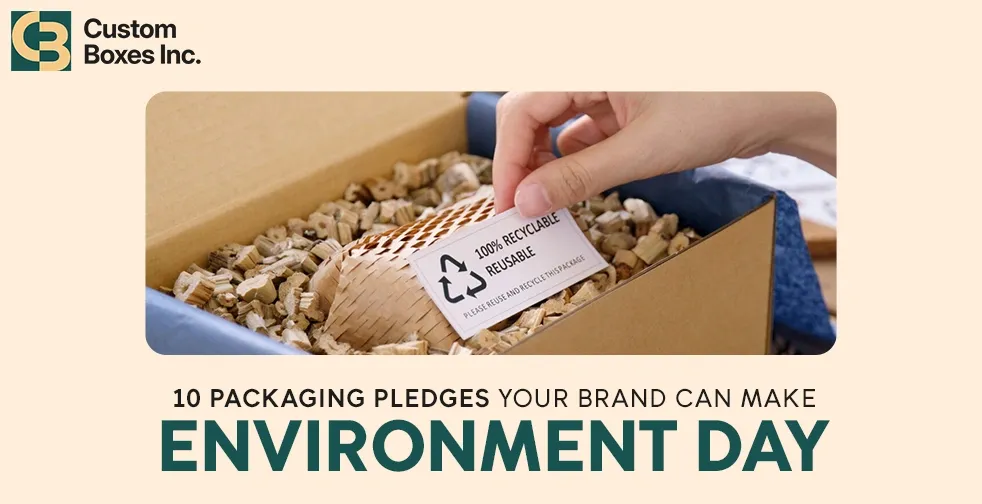
World Environment Day is celebrated on the 5th of June every year to remind us how to protect the planet. Brands must know that sayings or quotes alone are not enough; taking meaningful action is key to a clean environment.
Every year, brands commit to ending plastic pollution, but unfortunately, it’s limited to words. But 2026-30 will be the time the packaging box industry must think about this issue before it’s too late, because this industry is right at the center of that conversation.
In this blog post, we are going to talk about packaging pledges that your brand should make this Environment Day to show your part.
What are Packaging Pledges?
Packaging pledges are basically voluntary commitments to reduce packaging waste and promote greener practices. These pledges need to be implemented in a timely manner due to consumer demand and environmental goals.
Here are 10 pledges that you have to make this Environment Day.
1.Audit What You Are Actually Using
Before changing anything, you have to audit what you are actually doing. Don’t audit just one thing; think about all necessary checkpoints like materials, suppliers, quantities, and end-of-life outcomes. An honest audit is a must because, without it, you are just guessing.
2.Drop Single-Use Plastics From Your Primary Packaging
Single-use plastic is the main cause of environmental pollution. This one is one of the difficult pledges you have to make this Environment Day. Single-use plastic is cheap and effective, but it is a must to drop it from your primary packaging.
3.Switch to Packaging That's Recyclable
“Recyclable” is often considered one of the misleading terms in the packaging industry. Practical recyclability is far different from technical recyclability. Pledge to audit whether your packaging is actually accepted by curbside programs in your top markets. If it isn't, that label is doing more harm than good.
4.Reduce Packaging Weight and Volume by 20%
Excessive packaging creates many problems: increased shipping costs and pollutes the environment. When required, or less packaging material is used, less waste is expected, and shipping costs decrease. Work with your packaging supplier to choose materials that are not only lightweight in nature but also eco-friendly.
5.Remove Unnecessary Secondary Packaging
Brands nowadays customize packaging through secondary packaging. No doubt, it looks good, but on the contrary, it often includes material that is hard to recycle or cannot be recycled. Pledge to evaluate every piece of secondary packaging against a simple question: Does this serve a real protective or communicative function?
6.Pilot a Refill or Return Program
One of the most promising models of sustainability is refilling, and least used by mid-sized brands. Don’t overhaul the complete line. Decide to pilot a refill or return program for at least one product this year. Analyze things slowly and look at how much it would benefit your brand.
7.Require Transparency From Your Packaging Supplier
Many brands have adopted sustainable packaging on their own without asking too much from packaging suppliers. But for a better experience, pledge to ask your supplier unlimited questions, e.g., material sourcing, waste management, and recycled content.
8.Move Away From Mixed-Material Packaging
Mixed-material packaging is hard to recycle, and sometimes, it consists of plastic-coated paper, an enemy of the environment. These materials are often chosen because they perform well technically. But they create a waste stream that has nowhere to go. This Environment Day, pledge to identify mixed-material packaging and start changing to mono-material alternatives.
9.Set a Meaningful Recycled Content Target
Setting a meaningful target is a key to success. When you pledge to use recycled content in your packaging, you create a market demand for recycled materials. 30% recycled content in primary packaging by 2027 is achievable for most categories and genuinely moves the needle.
10.Talk About This Openly, Even When It's Messy
Those brands that don’t talk about their sustainability commitments stumble. They make internal commitments but do not express their thoughts openly. As a result, the efforts remain unacknowledged, and consumers have no signal to reward better behavior. Communicate your commitments transparently.
Final Words!
None of these commitments demands perfection on your part. What they demand is honesty about your current situation and intentionality about your direction.
The plastics problem isn't the result of the misdeeds of a few individuals or companies. No, it is the result of years and years and years of decisions by many companies to choose convenience over responsibility. And that means the answer to the problem is equally simple. Make different decisions over the years to come.
On Environment Day, Custom Boxes Inc encourages businesses to choose two or three achievable packaging pledges for this year. Define the changes and assign responsibility. Revisit the list next year and take on more.
That's not some earthshaking declaration. But change is actually like that.